
US Q1 GDP Revised Up to 2.1% as Investment and Exports Drive Growth
U.S. real GDP grew at an annualized 2.1% in the first quarter of 2026, higher than the previous 0.5% growth in Q4 2025. The figure was revised up from the second estimate of 1.6%, mainly because imports were revised lower, although consumer spending was also revised down. Growth was supported by investment, exports, government spending […]

U.S. real GDP grew at an annualized 2.1% in the first quarter of 2026, higher than the previous 0.5% growth in Q4 2025. The figure was revised up from the second estimate of 1.6%, mainly because imports were revised lower, although consumer spending was also revised down.

Growth was supported by investment, exports, government spending and consumer spending. Since imports reduce GDP calculations, the lower estimate for imports helped lift overall GDP. Investment, exports and government spending remained the main drivers of economic growth.

By industry, government value added increased 7.5%, private goods-producing industries rose 4.5%, and private services-producing industries gained 0.8%. The biggest positive contributors were information, federal government, professional, scientific and technical services, and durable goods manufacturing, while retail trade, wholesale trade, and finance & insurance weighed on growth.
Other key measures showed real final sales to private domestic purchasers rose 1.7%, real gross output increased 1.7%, real gross domestic income (GDI) climbed 1.2%, and the average of real GDP and GDI increased 1.7%. Corporate profits from current production rose $74.4 billion, revised up by $34 billion.
Inflation measures stayed elevated. The gross domestic purchases price index increased 3.6%, the PCE price index rose 4.6%, and the core PCE price index (excluding food and energy) increased 4.4%, unchanged from the previous estimate.
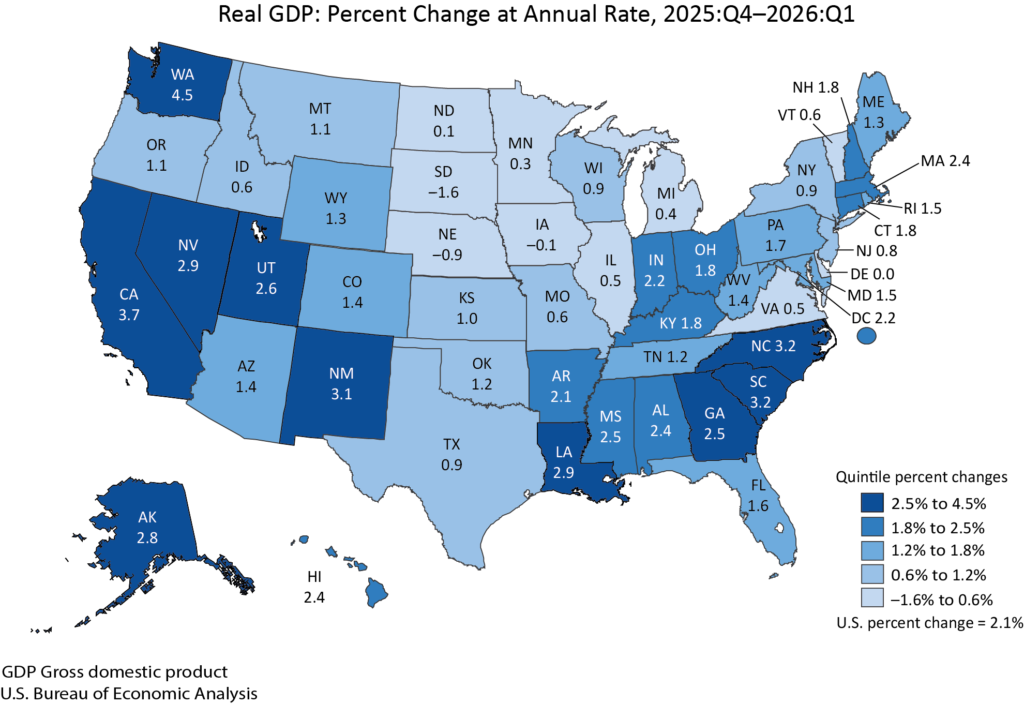
At the state level, real GDP increased in 46 states and Washington, D.C. Washington state recorded the strongest GDP growth at 4.5%, while South Dakota contracted 1.6%. Personal income rose $222.6 billion, or 3.4% annualized, increasing in 49 states and Washington, D.C. Personal income growth ranged from 22.4% in North Dakota to -23.9% in Hawaii, largely due to a decline in transfer payments after Maui wildfire-related settlement payments.

Related News

India Records 21% Rainfall Deficit as Monsoon Lags, Govt Rules Out Crop Impact
India’s Wind Power Capacity Hits 57,443 MW, Generation Surges in FY26

India’s Primary Energy Supply Rises to 39,055 PJ in FY25: MoSPI

Trump Unveils New US Tariff Plan for Generic Drug Imports from 2026

India’s Renewable Energy Capacity Hits 288.58 GW in 2026